

An Enduring Destination for Shared Discovery
Italy has long occupied a privileged position in the cultural imagination of travelers, offering a rare synthesis of history, art, gastronomy, and landscape. For couples seeking a refined and meaningful travel experience, the country presents a uniquely layered itinerary in which intimacy is shaped not only by setting but by shared intellectual and sensory engagement. From ancient ruins to Renaissance masterpieces, the density of cultural capital across Italy encourages deliberate, well-paced exploration rather than hurried consumption.
Cultural Density and the Logic of Itinerary Design
A defining characteristic of Italy is its extraordinary concentration of heritage sites, including an unparalleled 61 UNESCO World Heritage Sites. This distinction is not merely numerical; it reflects a continuum of artistic and architectural achievement spanning millennia. For couples, this offers the opportunity to structure travel around thematic coherence—whether Roman antiquity, medieval urbanism, or Baroque aesthetics—rather than geographic proximity alone. Cities such as Florence, Rome, and Venice reward extended stays, allowing travelers to move beyond iconic landmarks into quieter, more reflective spaces that foster deeper connection.
Urban Elegance and Intellectual Engagement
Major Italian cities remain essential for couples who value intellectual stimulation alongside aesthetic pleasure. In Florence, the interplay between humanist philosophy and artistic production is evident in institutions such as the Uffizi Gallery and the Accademia. Meanwhile, Rome offers a palimpsest of civilizations, where classical ruins coexist with ecclesiastical grandeur. Even in Venice, often associated with romantic cliché, a more measured exploration reveals a complex maritime republic whose legacy extends far beyond its canals. For couples, these cities provide not only visual richness but also opportunities for dialogue and shared interpretation.
Read More: From Sightseeing to Time-Feeling: The Evolution of Travel
Landscape, Slowness, and Sensory Experience
Beyond urban centers, Italy’s regional diversity allows couples to recalibrate their pace and engage with landscape as a primary mode of experience. The rolling hills of Tuscany, the dramatic coastline of the Amalfi Coast, and the alpine clarity of the Dolomites each offer distinct atmospheres conducive to reflection and intimacy. In these settings, the emphasis shifts from monumentality to rhythm—morning walks through vineyards, extended meals featuring regional cuisine, and the quiet observation of seasonal change. Such experiences underscore the importance of slowness as a principle of meaningful travel.
Southern Italy and the Value of Peripheral Exploration
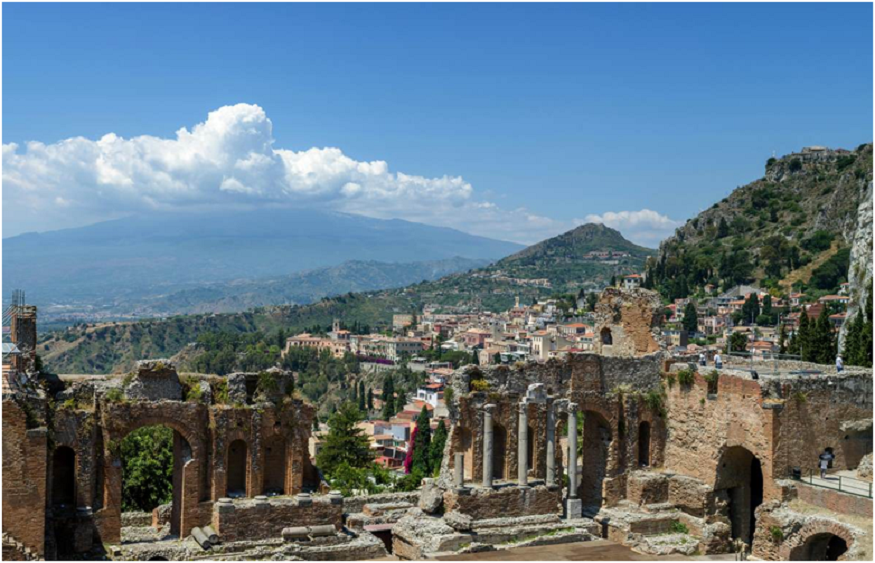
While northern and central Italy dominate most itineraries, the south offers equally compelling, if less codified, experiences. Sicily, in particular, presents a layered cultural landscape shaped by Greek, Roman, Arab, and Norman influences. Here, couples can balance archaeological exploration with coastal relaxation, creating a dynamic yet cohesive journey. A day trip to Tindari, for instance, allows travelers to encounter both ancient ruins and striking natural scenery, illustrating the region’s capacity to integrate history with environmental beauty. Such excursions exemplify the advantages of venturing beyond canonical destinations in search of more nuanced encounters.
Gastronomy as a Medium of Connection
Italian cuisine, often reduced to its globalized stereotypes, reveals its true complexity only through regional immersion. For couples, shared meals become a central component of the travel experience, offering insight into local identity and tradition. Whether sampling seafood along the Ligurian coast, truffle-based dishes in Piedmont, or citrus-infused specialties in Sicily, gastronomy operates as both cultural expression and social ritual. The act of dining—extended, deliberate, and communal—reinforces the broader ethos of Italian travel: an appreciation for quality, context, and continuity.
Read More: “Travel Trends in 2026: How Smarter Planning Is Changing the Way We Travel”
Toward a Deliberate and Shared Experience
Couple travel in Italy is most successful when approached as a process of curation rather than accumulation. The country’s richness demands selectivity, encouraging travelers to prioritize depth over breadth. By integrating cultural exploration, landscape appreciation, and culinary engagement, couples can construct an experience that is both intellectually rewarding and emotionally resonant. In this sense, Italy functions not merely as a destination but as a framework for shared exploration, where the interplay of past and present fosters a deeper understanding of both place and partnership.